
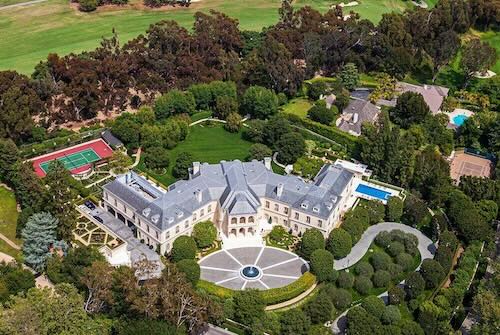
Holmby Hills is one of Los Angeles’ most storied estate neighborhoods, a quietly opulent enclave tucked between Beverly Hills, Westwood, and Bel Air. Along its curving lanes you’ll find some of the largest residential lots in the city, many approaching four acres, shaded by mature trees and illuminated at night by distinctive 1920s English-style street lamps created specifically for the neighborhood.
Location & boundaries
With the expansion of Sunset Boulevard, Holmby Hills evolved into two seamless but technically distinct sections. South of Sunset, the neighborhood stretches toward Wilshire Boulevard, bordered by Beverly Glen and Comstock on one side and the Los Angeles Country Club on the other; this portion is included in the Westwood Community Plan Area. North of Sunset, Holmby Hills climbs into the hills between Beverly Glen Boulevard and the Beverly Hills city limits, falling under the Bel Air–Beverly Crest Community Plan Area while remaining historically and architecturally distinct from both Bel Air and Beverly Crest.
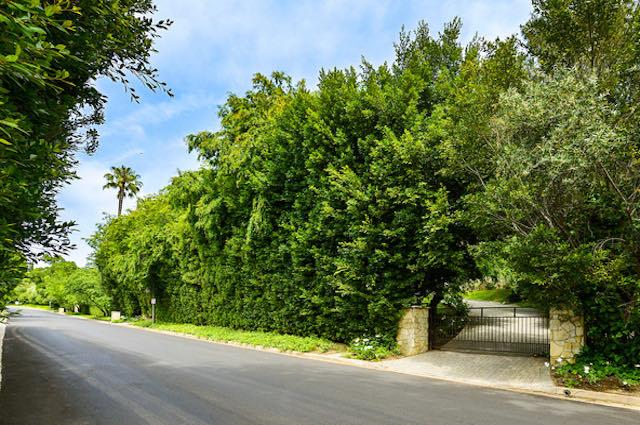
Zoning here was intentionally crafted for very low density, allowing estate lots up to roughly four acres. Streets such as Devon, Charing Cross, Conway, and others were named for places in England and Wales, a subtle nod to the neighborhood’s Anglo-European inspiration and the heritage of its founding family.
Early history & the creation of an estate district
Long before the gates and grand driveways, this land formed part of the Mexican-era Rancho San Jose de Buenos Ayres and later the Wolfskill Ranch, a vast agricultural holding on the undeveloped Westside. In 1919, department-store magnate Arthur Letts Sr.—the financial force behind The Broadway and Bullock’s purchased more than 3,000 acres of the former ranch. His vision was ambitious: a carefully planned district of retail, apartments, homes, estates, and a major university, which would ultimately become Westwood, Holmby Hills, and the campus of UCLA.
Letts carved out roughly 400 acres as a dedicated “estate section,” drawing on the name of his childhood village of Holdenby in England to coin “Holmby Hills” a name he had already used for his famed Los Feliz estate, Holmby House. After his death in 1923, development passed to his family and the Janss Investment Company, which also master-planned the rest of Westwood. The Janss firm marketed Holmby Hills as a refined alternative to other luxury tracts, emphasizing elevated views “without steep grades,” underground utilities, generous setbacks, and carefully controlled architecture.
Design details: lamps, lots, and leafy lanes
One of the most charming features of Holmby Hills is its original 1920s streetlighting. The Los Angeles Bureau of Street Lighting designed English-style standards solely for this neighborhood, today you can still tell when you’ve crossed into Holmby Hills simply by looking at the lamps.
Lots were platted at a grand scale, with deep, sweeping lawns and curving drives set far back from the street. Deed restrictions and careful planning kept utility lines out of view and preserved the area’s park-like feel. Many of the earliest houses arrived in the 1930s, after the Wall Street Crash, when ultra-wealthy buyers commissioned architects to design estates that could rival anything in Europe: English country manors, French château–style residences, Tuscan villas, and more.
Architectural landmarks & famous estates
Holmby Hills is home to some of the best-known properties on the planet. The Manor (formerly the Spelling Manor), a 56,500-square-foot French château–style residence on Mapleton Drive, was built for television producer Aaron Spelling in the late 1980s and sits on roughly 4.6 acres fronting Holmby Park and the Los Angeles Country Club. It remains one of the largest private homes in the United States and recently changed hands again, now owned by Eric Schmidt, former CEO of Google.
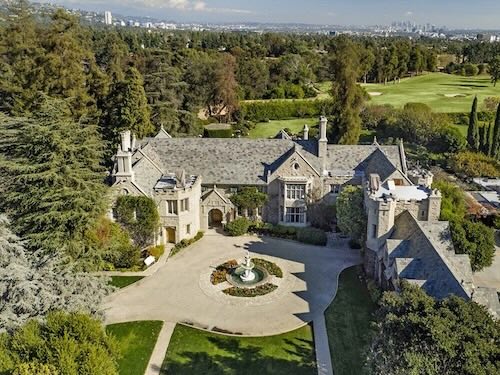
Just up the hill, the Gothic Tudor–style Playboy Mansion on Charing Cross Road helped cement Holmby Hills’ global reputation. The nearly 20,000-square-foot estate sits on about five acres and is one of very few private homes in Los Angeles with a zoo license—a quirky distinction that once made its grounds as famous as its parties. The property has recently undergone a multi-year restoration led by architect Richard Landry, giving new life to one of LA’s most mythologized addresses.
Other icons include the Tuscan-style Owlwood Estate on Carolwood Drive once Los Angeles’ largest house when it was completed in 1937 and long regarded as the “crown jewel” of Holmby Hills as well as the Carolwood Estate, built on the former five-acre property where Walt Disney once lived and famously ran a miniature railroad in his backyard.
Over the decades, Holmby Hills has been home to a who’s who of entertainment and business: Marilyn Monroe, Sonny and Cher, Barbra Streisand, Nat King Cole, Elvis Presley, Michael Jackson, and many other figures whose careers defined Hollywood’s golden age and beyond. More recent residents have included tech leaders and global entrepreneurs, reflecting how the neighborhood continues to evolve with each era.
Holmby Park & everyday life
While Holmby Hills is known for its privacy, there is one truly public heart: Holmby Park. Created in the 1920s when the Janss Investment Company deeded land to the city, the park sits between Mapleton Drive and Beverly Glen, offering lawns, playgrounds, picnic areas, and a small pitch-and-putt course now known as the Armand Hammer Golf Course.
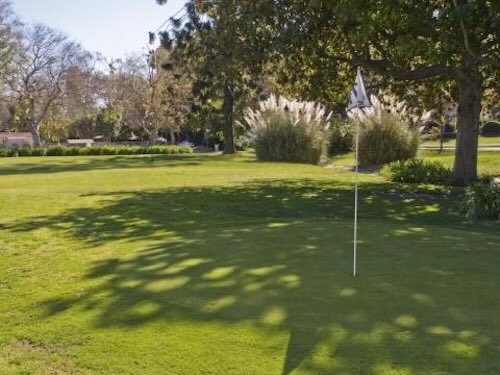
Holmby Park is also home to the Holmby Park Lawn Bowling Club, established in 1927 and still active today, offering lessons and league play on manicured greens. Over the years the park has quietly hosted everyone from Frank Sinatra to Ronald Reagan, and even today it’s not unusual to see industry figures walking dogs, meeting friends, or relaxing under the trees in this improbably low-key corner of one of LA’s most exclusive neighborhoods.
Lifestyle & real estate today
Day-to-day life in Holmby Hills is defined by privacy, space, and a sense of quiet that feels worlds away from Wilshire Boulevard or nearby UCLA despite being only minutes from Westwood Village, Beverly Hills’ Golden Triangle, and Century City’s office towers and shopping. Many homes are screened by mature landscaping and long gated drives, and the neighborhood’s meandering streets see relatively little through traffic, making it popular with residents who value security and discretion above all.
The housing stock is almost entirely made up of custom-built estates, often with tennis courts, pools, guesthouses, and elaborate gardens. Some properties are lovingly preserved time capsules of mid-century or 1930s design; others have been fully reimagined with contemporary architecture, wellness spas, and smart-home technology. Newer buyers range from legacy LA families to international clients seeking a flagship West Coast residence. For all of them, Holmby Hills offers something rare: a grand, historically rich estate district that still feels like a secluded, leafy retreat at the center of Los Angeles.
Leave a Reply