
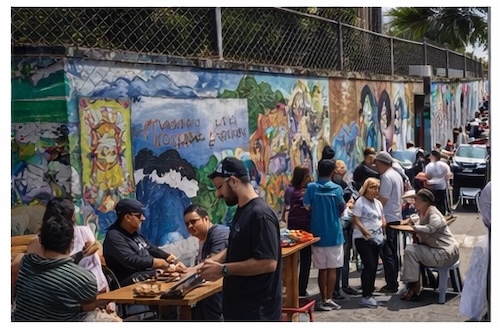
Pico Union is one of Los Angeles’ oldest residential districts and one of its most dynamic gateways, sitting immediately west of Downtown between Olympic Boulevard, Normandie Avenue, the Harbor Freeway, and the Santa Monica Freeway. It bridges Central LA and the Westside, bordered by Koreatown and Westlake to the north, Downtown to the east, Adams-Normandie, University Park, and Exposition Park to the south, and Harvard Heights to the west.
Today, Pico Union is known for its dense urban fabric, historic architecture, and a strong Central American presence that has reshaped the neighborhood’s culture, food, and streetscape over the last several decades.
Long before the freeways, Pico Union sat within the original boundary of El Pueblo de Los Ángeles, founded in 1781, and earlier still was home to the Tongva village of Geveronga. In the early 20th century, the area evolved into a fashionable suburb of Westlake, marketed to a growing middle and upper-middle class who were drawn by streetcar access and proximity to both Downtown and the emerging Wilshire District. Large single-family homes and stately apartment buildings went up along tree-lined streets, many designed by noted architects such as Frank Tyler, Hunt & Burns, Stiles O. Clements, and Elmer Grey. These early decades left Pico Union with an unusually rich mix of Victorian cottages, Craftsman and Mission Revival bungalows, and grand Period Revival residences.
After World War II, like many inner-city neighborhoods, Pico Union saw an outflow of affluent residents to newer suburbs. Freeway construction hemmed the district in, and by the 1960s vacancy and disinvestment were common. In the late 1970s and 1980s, however, the area took on a new role as a primary point of entry for immigrants from El Salvador, Guatemala, and other parts of Central America fleeing civil wars and political violence. Their arrival reshaped Pico Union into one of the most important Central American communities in the United States, a character that remains central to the neighborhood’s identity today.
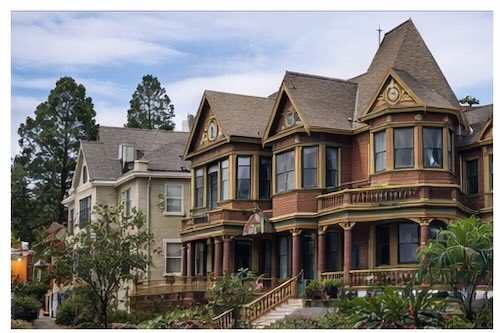
Architecturally, much of that early housing stock survives, protected under the Pico-Union Historic Preservation Overlay Zone, adopted in 2004 as the city’s 19th HPOZ. Within it are two National Register–listed historic districts: the Alvarado Terrace Historic District and the South Bonnie Brae Tract Historic District, where intact blocks of ornate homes and apartment houses line gently sloping streets. In Alvarado Terrace you’ll find everything from turreted Victorian mansions to Craftsman foursquares and apartment courts, plus one quirky landmark: Powell Place, a tiny 13-foot brick lane often cited as one of Los Angeles’ shortest streets. For architecture lovers, these pockets feel like time capsules just minutes from the towers of Downtown.
Daily life in Pico Union reflects its Central American heart. Along Pico, Olympic, and Washington Boulevards are clusters of pupuserías, panaderías, tortillerías, and small markets, many signed in Spanish and decorated with murals referencing Salvadoran and Guatemalan history. The designation of the El Salvador Community Corridor along a stretch of Vermont Avenue in 2012 recognized the neighborhood’s status as a cultural home for Salvadorans in Los Angeles; street-pole banners, vivid public art, and the smell of pupusas and yuca frita reinforce that identity at street level. Weekend street vendors, informal food stands, and small family-run businesses add to the sense of a busy, walkable urban district.
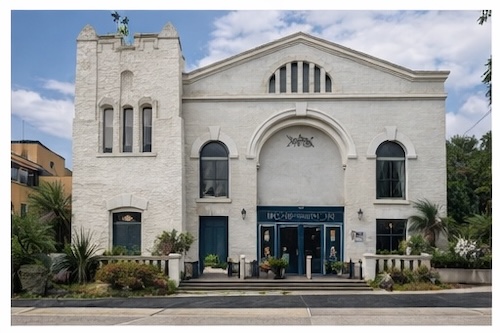
Pico Union also has notable religious and cultural landmarks that reflect its layered past. The Pico Union Project, housed in the 1909 former Sinai Temple, the oldest standing synagogue building in Los Angeles, now serves as a multi-faith cultural and arts center, hosting concerts, services, and community events in a restored sanctuary. Nearby churches, from modest storefront congregations to historic sanctuaries, speak to the area’s long role as a landing place for successive waves of immigrants. The neighborhood’s schools, library branch, and community organizations anchor everyday life for residents, many of whom walk to work, school, or transit.

Housing in Pico Union is diverse and often dense. Grand single-family homes that once housed one or two families have in many cases been converted into multi-unit dwellings, duplexes, or rooming houses, while courtyard apartments, small walk-ups, and newer infill buildings line the busier boulevards. The result is one of the most population-dense neighborhoods in Los Angeles, with a young median age and a strong renter population.
Despite the density, many residential streets still feel intimate, with mature trees, front porches, and neighbors who have known one another for years.

Connectivity is one of Pico Union’s practical advantages. Wedged between the 10 and 110 freeways and just west of Downtown, the neighborhood offers quick access to the city’s employment cores, USC and Exposition Park to the south, and Koreatown and Westlake to the north. Bus lines on Pico, Olympic, Venice, and Vermont, along with nearby Metro rail connections in Downtown and University Park, make it appealing for transit-oriented living. Recent years have brought renewed interest and investment, with proposals for new housing, hotels, and infrastructure improvements reflecting its strategic location.
Today, Pico Union stands at the intersection of preservation and change. Its historic homes and designated districts protect a rare early-20th-century streetscape, while its Central American restaurants, markets, and cultural corridors keep the neighborhood’s immigrant story very much alive. For anyone interested in Los Angeles history, architecture, or food, Pico Union offers a dense, walkable slice of the city where the past and present sit side by side on every block.
Leave a Reply