

Angelino Heights is one of L.A.’s most cinematic historic enclaves: a steep hillside neighborhood just northwest of Downtown, perched above Echo Park Lake, with a rare concentration of late-19th-century Victorian homes and an unusually intact streetscape. The City of Los Angeles calls it “often” the city’s first suburb, planned as a genteel Victorian neighborhood for the late-1800s upper-middle class, and it became L.A.’s first Historic Preservation Overlay Zone (HPOZ).
Location and boundaries
Angelino Heights sits between Echo Park and the edges of the 101, close enough to Downtown that the skyline often feels like part of the view. The neighborhood is generally framed by Sunset Boulevard on the north/east, Echo Park Lake on the west, and the Hollywood Freeway (US-101) along the south side.
The Angelino Heights HPOZ boundary map also highlights the core hill streets; Edgeware Rd, Carroll Ave, Kellam Ave, Douglas St, Innes Ave, Kensington Rd, Laveta Terrace and more—showing how compact (and walkable) the historic district really is.
Historical background
Angelino Heights was recorded during L.A.’s boom-era expansion in the 1880s, and the neighborhood developed as one of the first “ring” suburbs around the old city core.
Transit helped drive that growth: the National Register nomination for the Carroll Avenue district notes the Temple Street cable railway era and later streetcar service that made the Heights feel accessible from Downtown in the late 19th and early 20th centuries.
Preservation is a huge part of the modern story. The 1300 block of Carroll Avenue was listed as a National Register Historic District in 1976, and Angelino Heights became the city’s first HPOZ soon after.
Architecture and housing character
This is one of the best neighborhoods in Los Angeles for “readable history” in the built environment. The signature inventory includes:
- Queen Anne / Eastlake Victorians (ornate woodwork, turrets, spindlework, patterned shingles), especially concentrated on Carroll Avenue.
- Turn-of-the-century transitions into simpler forms, plus later layers like Craftsman and Mission Revival noted by City Planning.
A cool detail from the National Register documentation: the 1300 block of Carroll is notable not just for individual houses, but for preserving the feeling of a complete Victorian residential streetscape with minimal intrusion from later large-scale development.
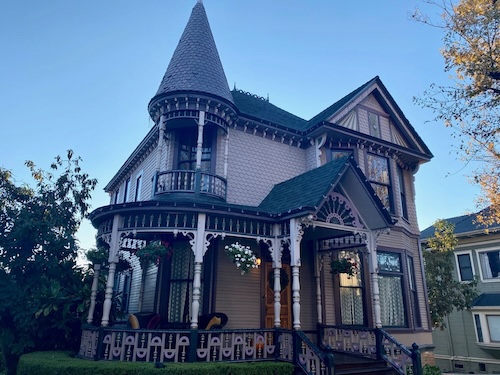
Because it’s a protected historic area, remodels and new construction are generally expected to respect neighborhood scale, massing, and materials under HPOZ guidelines.
Micro-neighborhoods within Angelino Heights
Angelino Heights is small, but it has distinct “mini pockets” that feel different block-to-block.
1) Carroll Avenue Historic District (the crown jewel)
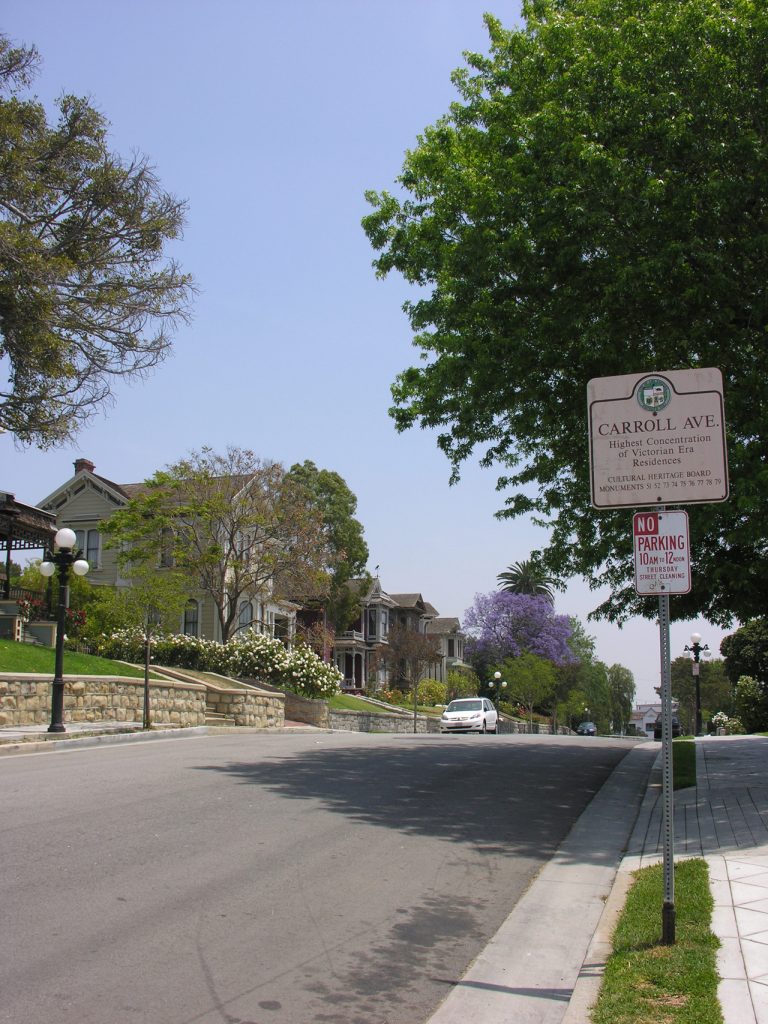
The 1300 block of Carroll Avenue (between Edgeware and Douglas) is the marquee: the National Register nomination calls it the highest concentration of Victorian-era residences still existing in the city at the time of listing, and it inventories the landmark homes along the block.
Notable standouts include:
- Phillips House (1300 Carroll Ave, 1887) – one of the most ornate homes in the neighborhood, blending Queen Anne exuberance with Eastlake detail.
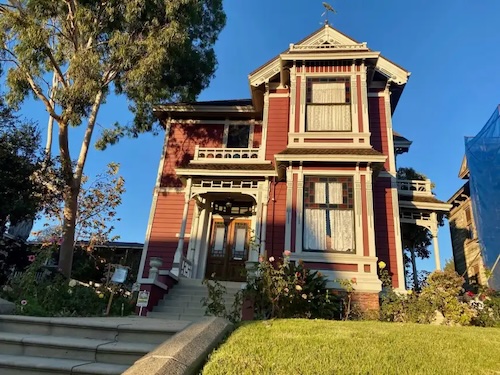
- Innes House (1329 Carroll Ave) – a key Carroll Avenue original, later famous as the “Charmed” house; the Conservancy describes its Eastlake design and interior Victorian features.
- Haskins House (built 1894) – described by the Conservancy as the last Victorian built on Carroll and one of the few “Gay Nineties” houses remaining in L.A.
- Heim House – another original Carroll Avenue Victorian-era residence tied to early Angelino Heights development.
2) Edgeware Road ridge and view streets
Edgeware and nearby hillside streets function like the neighborhood’s “balcony,” with sightlines toward Downtown and Echo Park. It’s also where you feel the topography most: crest streets, tight curves, and short stair-like connections that reflect the hill suburb layout. (Edgeware is also prominent on the HPOZ boundary map.)
3) Kensington and Laveta terraces (hillside texture)
The HPOZ map highlights Kensington Rd and Laveta Terrace as part of the protected fabric—quieter, residential hillside blocks that read less “tour stop” and more “lived-in historic neighborhood.”
4) Echo Park Avenue edge (the transition zone)
On the west side, the neighborhood blends toward Echo Park Lake and the busier Echo Park Avenue corridor, still historic, but more connected to daily foot traffic, lake loops, cafés, and transit.
Special historic locations and “only-in-L.A.” landmarks
Angelino Heights HPOZ
Angelino Heights’ identity is inseparable from being the first HPOZ in Los Angeles, with formal preservation tools and mapped boundaries maintained by City Planning.
Carroll Avenue as a citywide landmark street
The National Register documentation emphasizes that Carroll Avenue is an unusually intact “cluster” of Victorians in their original setting—an increasingly rare thing in Los Angeles.
Filming legacy (with a real neighborhood behind it)
Carroll Avenue’s Victorians have appeared in countless productions; even recent travel/walking write-ups point visitors to the block for recognizable houses and the broader “historic home walk” experience. (Practical note: these are private residences, admire from the sidewalk.)
Parks, views, and what it feels like day-to-day
Angelino Heights is a “walk it slow” neighborhood: short distances, big elevation changes, and constant visual rewards—porches, gables, trim details, skyline peeks. Many people pair it with an Echo Park Lake loop or a neighborhood staircase walk that naturally passes by Carroll Avenue.
Getting around
You’re minutes from Downtown by car, with quick access to Sunset and nearby arterials, and you’re also right next to the 101 corridor (which defines the south edge of the HPOZ map).
It’s a very “central L.A.” location, but the interior blocks can feel surprisingly removed once you’re up on the hill.
Who Angelino Heights is for:
- Buyers and renters who want historic character and a neighborhood that feels like “old Los Angeles” rather than a blank-slate subdivision.
- Architecture lovers who value Victorian-era detail and preservation protections.
- People who want Echo Park/Silver Lake/Downtown proximity without living directly on the busiest commercial strips.
Leave a Reply