
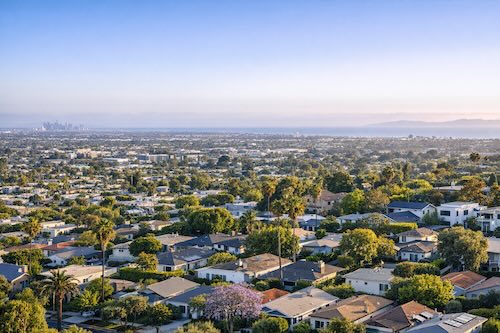
Mar Vista sits in the Westside of Los Angeles, just inland from Venice and Santa Monica. Officially, the neighborhood is bounded by the Santa Monica city line and the 10 freeway to the north, Walgrove Avenue and Centinela to the west, the Culver City border to the south, and the 405 freeway to the east.
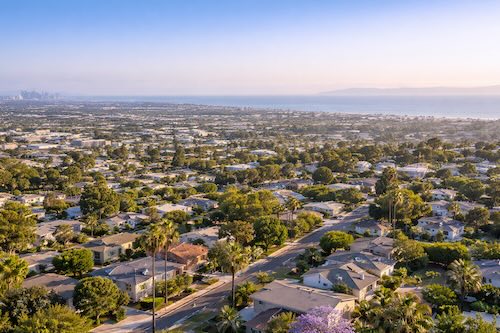
It’s a primarily residential community of about 2.9 square miles with a mix of single-family homes, small apartment buildings, and a growing number of modern infill projects. As surrounding Westside markets like Venice, Santa Monica, and Playa Vista have boomed, Mar Vista has evolved from “quiet and out of the way” to a core Westside address, while still keeping a more low-key, neighborhood-forward feel.
Historical Background
From 1904 to 1924, the area was known as Ocean Park Heights, a streetcar suburb developed along the Venice Short Line, an interurban rail route that connected Downtown Los Angeles to Venice Beach along what is now Venice Boulevard.
In 1924 the community adopted the name Mar Vista (“view of the sea” in Spanish), and in 1927 it became the 70th community to be annexed into the City of Los Angeles. Much of the early commercial development clustered around Venice and Grand View, where an overhead “MAR VISTA” sign once stretched across the intersection, announcing the community to passing motorists and Pacific Electric riders.
Massive growth came in the 1950s–1970s, when large tracts north of Venice Boulevard were built out with modest single-family homes, many in a clean mid-century style. These houses were originally lower-cost options on what was then the city’s fringe, but over time and as the Westside turned into a major business and tech hub values climbed dramatically. Older homes marketed as tear-downs now routinely sell well above $1 million, and many lots have been redeveloped with larger contemporary residences.
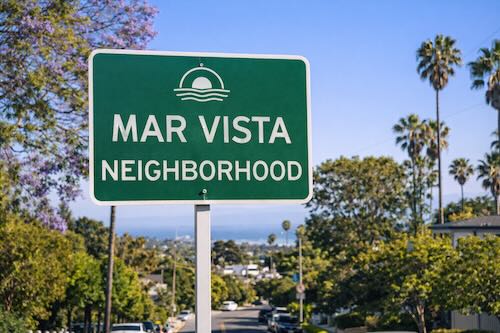
In 2006, the City of Los Angeles formally designated Mar Vista as an official neighborhood and installed signage at key gateways, further solidifying its identity within the Westside.
Land Use, Architecture & Housing
Mar Vista is defined by a strong single-family core north of Venice Boulevard, especially along streets like Beethoven, Meier, Moore, and the hill streets that climb toward National. Many of these homes retain mid-century massing and rooflines even as they’re remodeled or expanded stucco ranches, low-rise traditional homes, and modern farmhouses all share the same blocks.
South of Venice Boulevard, zoning swings toward apartments and small multi-family buildings, including a significant number of classic “dingbat” buildings from the 1950s and 1960s. Many of these are subject to Los Angeles’ Rent Stabilization Ordinance, which has allowed long-term renters to remain in the neighborhood despite rising land values.
Overlaying that base is a set of historic and character pockets; Mar Vista Hill, Westdale Trousdale, the Oval District, and Mormon Hill, each with its own development story, lot sizes, and architectural flavor.
Lifestyle, Commercial Corridors & Community
Mar Vista manages to feel both residential and plugged-in. The stretch of Venice Boulevard around Grand View forms a kind of “downtown Mar Vista,” with older commercial buildings (1920s–1960s) now home to craft coffee, eateries, tattoo parlors, neighborhood shops, and a popular weekly farmers market.
A few blocks around Centinela and Windward, historically known as Mormon Hill, still function as a local center, anchored by an LDS church and surrounded by long-standing commercial storefronts originally built to serve a 1920s Mormon settlement. Today, the strip along Venice remains a mix of quirky, boisterous past and ongoing gentrification.
Community identity is reinforced by active neighborhood associations and the Mar Vista Community Council, which divides the area into zones and sponsors events like picnics, outreach, and local forums. The result is a place where block-by-block, you feel neighbors actually using local parks, walking dogs, biking to the beach, and attending community meetings.
Parks, Open Space & Connectivity
While Mar Vista doesn’t have a single giant park like Griffith, it’s threaded with local parks, gardens, and recreation areas, including:
- Mar Vista Park, a central recreation hub with fields, courts, and programs (also home to North Venice Little League).
- Ocean View Farms / Community Garden on Mar Vista Hill, where residents cultivate garden plots on land that has cycled through many uses, from farmland to dump to an anti-aircraft site before becoming a community garden.
To the west and south, residents are a short drive or bike ride from Venice Beach, the Ballona Creek bike path, and parks in adjacent Venice and Culver City.
Connectivity is excellent: Venice Boulevard, the 405, and nearby transit lines make it easy to reach Santa Monica, the South Bay, Culver City, and even DTLA, part of why Mar Vista has become a favored base for tech and creative professionals.
Leave a Reply